| The Berry House
A Brief History and The Lincoln Connection 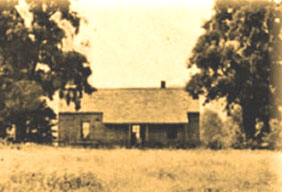 In 1831, Abraham Lincoln arrived in a flat boat in New Salem, Illinois, where he would live for the next seven years. He soon made friends with William Franklin Berry, a hard-working young man who was the son of Reverend John Berry, founder of Rock Creek Cumberland Presbyterian Church. In New Salem, William Berry and Abraham Lincoln founded two Berry-Lincoln stores; and for a short time, the two men were thriving merchants. In 1831, Abraham Lincoln arrived in a flat boat in New Salem, Illinois, where he would live for the next seven years. He soon made friends with William Franklin Berry, a hard-working young man who was the son of Reverend John Berry, founder of Rock Creek Cumberland Presbyterian Church. In New Salem, William Berry and Abraham Lincoln founded two Berry-Lincoln stores; and for a short time, the two men were thriving merchants.
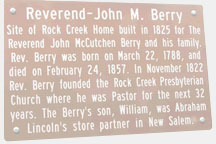 The Berry family came from Kentucky in 1822, in a Conestoga wagon, to start a new church at Rock Creek, Illinois. The family built a one-room log cabin in which to live, until a permanent home could be built next door. They hired D.S. Taylor to build a multi-room dream house that was unlike anything in the area, at the time. The house had frame construction with oak and walnut panels, as opposed to the common log houses in New Salem. It was built over a full-sized, deep cellar, which was practically unheard of at the time; and the house featured whitewashed plastered floors and walls. The Berry family came from Kentucky in 1822, in a Conestoga wagon, to start a new church at Rock Creek, Illinois. The family built a one-room log cabin in which to live, until a permanent home could be built next door. They hired D.S. Taylor to build a multi-room dream house that was unlike anything in the area, at the time. The house had frame construction with oak and walnut panels, as opposed to the common log houses in New Salem. It was built over a full-sized, deep cellar, which was practically unheard of at the time; and the house featured whitewashed plastered floors and walls.
Lincoln was a frequent visitor to the house - not only to see his friend William, but Lincoln also visited the house to discuss Whigism with Rev. Berry and to attend Sunday night church services, in the parlor room. Rev. Berry sometimes held the evening services in his home, rather than heat the entire church for such a small, intimate gathering. The home also served as a voting place for elections, and Lincoln served as judge in at least one election there.
After Lincoln left New Salem to pursue a career as a lawyer, he received news that his sweetheart, Ann Rutledge, was dying. He made the long trip from Vandalia, the former Illinois state capital, to her home in Concord, north of Petersburg, Illinois. On the way to his destination, he stopped at the Berry home and was invited to spend the night. Lincoln was so distraught and depressed, however, that he paced the floor until dawn, when he could complete his journey to find Ann on her deathbed. The Berry farm expanded and included a 40-acre tract, joining a similar tract of land owned by Reverend Cameron, the founder of New Salem. In the early 1900s, the Berry house was converted into a corn crib and eventually abandoned, allowed to decay and to be overgrown with brush and vines, until it was documented, salvaged, and razed in 2001. Robert Sampson | Berry House History | Limited Collectors Items |